
- Atomic Habits: An Easy & Proven Way to Build Good Habits & Break Bad Ones
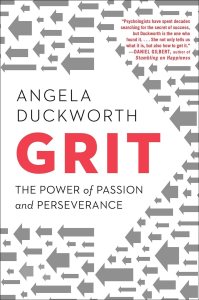
- *NEW* Grit: The Power of Passion and Perseverance
- How to Know a Person: The Art of Seeing Others Deeply and Being Deeply Seen
- Ikigai: The Japanese Secret to a Long and Happy Life (incomplete)
- The Alchemist
- The Life-Changing Magic of Tidying Up: The Japanese Art of Decluttering and Organizing
- The Little Prince

- TITLE: Atomic Habits: An Easy & Proven Way to Build Good Habits & Break Bad Ones
- AUTHOR: James Clear
- MY KEY TAKEAWAYS:
- Whether good or bad, habits accumulate and produce results that multiply rapidly just like compound interest. A daily improvement or regression of 1% will leave you 37 times better or worse at the end of a year.
- Instead of focusing on the outcome you seek to achieve, which may seem so far off, spend time creating an effective structure that allows you to progress toward the goal. Lasting change comes from creating the proper process and automating procedures.
- Frequency is more important than duration when it comes to habit formation. Apply the two-minute rule: each new habit shouldn’t take more than two minutes.
- A habit can become enticing if it has the right visual cues attached to it. Make cues for good habits easy to see and cues for bad habits hard to see.
- It’s easier to learn a new habit when you attach it to an existing one. Use Habit Stacking to create chains of good habits.
- *NEW*
- TITLE: Grit: The Power of Passion and Perseverance
- AUTHOR: Angela Duckworth
- MY KEY TAKEAWAYS:
- Grit has two components: Passion and Perseverance.
- Passion is the ability to work toward distant objectives/goals. It is not about intensity. It is about consistency over time.
- Perseverance is the quiet determination to stick to a course once decided upon and not abandoning it just because it is difficult.
- How to improve Grit:
- Interest: Passion begins with intrinsically enjoying what you do.
- Practice: You have to have the daily discipline to try to do things better.
- Purpose: What ripens passion is the conviction that your work matters to others.
- Hope: The belief that you have the power to make things better.
- 1. Interest:
- Early interests are fragile, and if you don’t spend time playfully exploring and repeatedly exposing yourself to an interest, it will die out before it becomes a passion.
- Questions to ask to figure out what might become a passion of yours:
- What do I like to think about?
- Where does my mind wander?
- What do I really care about?
- What matters most to me?
- How do I enjoy spending my time?
- What do I find absolutely unbearable?
- 2. Practice:
- It takes 10,000 hours of Deliberate Practice to become an expert at something. (That’s 3 hours a day for almost 10 years.)
- What is Deliberate Practice?
- Clearly defined stretch goals.
- Full concentration and effort.
- Immediate and informative feedback.
- Repetition with reflection and refinement.
- 3. Purpose:
- Grittier people are dramatically more motivated than others to seek a meaningful, other-centered life.
- Reflect on how the work you’re already doing can make a positive contribution to society.
- Think about how, in small but meaningful ways, you can change your current work to enhance its connection to your core values.
- Find inspiration in a purposeful role model.
- 4. Hope:
- The type of hope that gritty people have rests on the expectation that their own efforts can improve their future. I “resolve to make tomorrow better” rather than I “have a feeling tomorrow” will be better.
- You should have a “Growth Mindset.” Believe, deep down, that people, including yourself, really can change.
- If you experience adversity that you overcome on your own, you develop a different way of dealing with adversity later on. On the other hand, achievement without adversity results in you becoming a “Fragile Perfect.” Your first failure will devastate you.
- Parenting for Grit:
- You have to be both supportive AND demanding.
- Supportive:
- I can count on my parents to help me out if I have a problem.
- My parents spend time just talking to me.
- My parents and I do things that are fun together.
- My parents believe I have a right to my own point of view.
- My parents respect my privacy.
- My parents give me a lot of freedom.
- Demanding:
- My parents really expect me to follow family rules.
- My parents point out ways I could do better.
- My parents expect me to do my best even when it’s hard.
- People like to believe there are geniuses out there who have natural talent and do not need to practice. We convince ourselves of this so we can let ourselves off the hook for not being good at something. But greatness comes more from effort than ability.
- Grit has two components: Passion and Perseverance.
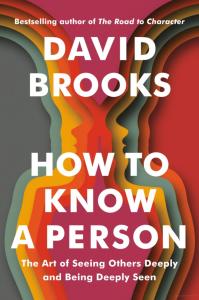
- TITLE: How to Know a Person: The Art of Seeing Others Deeply and Being Deeply Seen
- AUTHOR: David Brooks
- MY KEY TAKEAWAYS:
- Traits for Memorable Conversationalists
- Ideal:
- Illuminators:
- People who excel in truly listening and asking excellent questions.
- Everyone around them feels visible and valued.
- Illuminators:
- Not Ideal:
- Attention Seekers:
- People who always offer witty insights on various topics
- People who tell jokes that make everyone laugh
- Attention Seekers:
- Ideal:
- “The greatest art is guiding others to answer, not serving it on a silver platter.”
- How to be an Illuminator:
- Genuinely Respect Others: everyone is better than us in some aspect.
- Be Curious
- Focus on the Viewpoint, Not the Situation: a listener needs to be patient and try to figure out what makes an event crucial to the speaker, which might have very little to do with what actually happened.
- “We do not see things as they are, we see things as we are.” – Anais Nin
- How to Improve Empathy:
- Observe gestures and intonations and mirror them.
- Read memoirs and stories with complex characters.
- Practice deducing what a speaker’s current unstated Primary Life Motivator is:
- Imperial: Motivated by showing what one is capable of and impressing others.
- Interpersonal: Motivated by finding one’s tribe and fitting into it. Describes themselves though their relationships with others.
- Career: Motivated by mastering a specific field.
- Generative: Motivated by guiding others and helping the world.
- Communication Don’ts:
- Don’t try to formulate a response while a person is speaking. Focus on their message fully and pause and respond afterwards.
- Don’t be passive. Instead, show signs of listening such as nodding, leaning forward, and commenting.
- Don’t always try to share similar experiences. It may seem like supporting a dialog but it is often a way to shift attention to ourselves.
- Traits for Memorable Conversationalists
- Asking the Right Questions:
- Choose a humble, not a superior stance.
- Ask open-ended but specific questions.
- Handling Emotionally Charged Conversations:
- Bring Back Awareness: Pause, mentally distance ourselves from the argument, and ask “What has brought us to this heated discussion?”
- Clarify Intentions
- Find a Point of Agreement
- Re-frame Disagreement as a Chance for Growth
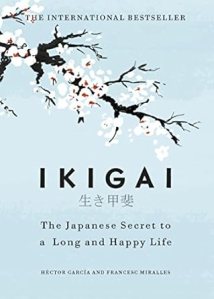
- TITLE: Ikigai: The Japanese Secret to a Long and Happy Life
- AUTHORS: Hector Garcia, Francesc Miralles
- MY KEY TAKEAWAYS:
- Ikigai is a Japanese concept that translates roughly as “the happiness of always being busy.”
- Everyone has an ikigai. Some people have found their ikigai, while others are still looking, though they carry it within them. It is the reason we get up in the morning.
- Maintaining an active, adaptable mind is one of the key factors in staying young. Dealing with new situations, learning something new every day, playing games, and interacting with other people seem to be essential anti-aging strategies for the mind.
- Elements that shorten your lifespan:
- Sustained or intense stress
- Too much sitting
- Too much eating
- Insufficient sleep
- A negative attitude
- Morita Therapy:
- Phase 1: Isolation and rest by staying in a room without any external stimuli. All the patient has is his or her own thoughts.
- Phase 2: Perform repetitive tasks such as gardening, drawing, and painting in silence.
- Phase 3: Perform activities with others but only allowed to talk about the tasks at hand.
- Phase 4: Return to social life. The idea is to re-enter society as a new person, with a sense of purpose, and without being controlled by social or emotional pressures.
- Naikan Meditation:
- 1. What have I received from person X?
- 2. What have I given to person X?
- 3. What problems have I caused person X?
- Find Flow in everything you do. There is no future, no past. There is only the present. You are completely immersed in the experience, not thinking about or distracted by anything else. Your ego dissolves, and you become part of what you are doing.
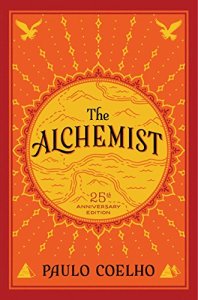
- TITLE: The Alchemist
- AUTHOR: Paulo Coelho
- MY FAVORITE QUOTES:
- “When you want something, all the universe conspires in helping you to achieve it.”
- “It’s the possibility of having a dream come true that makes life interesting.”
- “Everyone seems to have a clear idea of how other people should lead their lives, but none about his or her own.”
- “There was a language in the world that everyone understood. It was the language of enthusiasm, of things accomplished with love and purpose, and as part of a search for something believed in and desired.”
- “I can always go back to being a shepherd, the boy thought. I learned how to care for sheep, and I haven’t forgotten how that’s done. But maybe I’ll never have another chance to get to the Pyramids in Egypt.”
- “It was my fear of failure that first kept me from attempting the Master Work. Now, I’m beginning what I could have started ten years ago. But I’m happy at least that I didn’t wait twenty years.”
- “I’m going away,” he said. “And I want you to know that I’m coming back. I love you because …”
“Don’t say anything,” Fatima interrupted. “One is loved because one is loved. No reason is needed for loving.” - “That’s what alchemists do. They show that, when we strive to become better than we are, everything around us becomes better, too.”
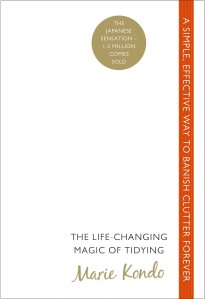
- TITLE: The Life-Changing Magic of Tidying Up: The Japanese Art of Decluttering and Organizing
- AUTHOR: Marie Kondo
- MY KEY TAKEAWAYS:
- Marie Kondo’s Konmari Method: “When you remove the useless things around you, you create enough space for other things that are valuable to your life.”
- “Tidying is more than just getting rid of physical garbage. It helps clear the mind and soul of mental garbage, too.”
- Choose what to discard by asking the question “does it spark joy?”
- Don’t tidy up clutter based on a particular location. Instead tidy up by category by bringing all of the related things in the house together so that you can sort and discard them at once.
- “Pursue ultimate simplicity in storage–store things in simple storages where you’ll be able to access them easily.”
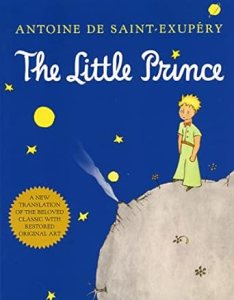
- TITLE: The Little Prince
- AUTHOR: Antoine de Saint-Exupery
- MY FAVORITE QUOTES:
- “It’s the time you spent on your rose that makes your rose so important.”
- “Grown-ups like numbers. When you tell them about a new friend, they never ask questions about what really matters. They never ask: “What does his voice sound like?” “What games does he like best?” “Does he collect butterflies?” They ask: “How old is he?” “How many brothers does he have?” “How much money does his father make?” Only then do they think they know him.”
- “I know a planet inhabited by a red-faced gentleman. He’s never smelled a flower. He’s never looked at a star. He’s never loved anyone. He’s never done anything except add up numbers. And all day long he says over and over, ‘I’m a serious man! I’m a serious man!” And that puffs him up with pride.
- “You own the stars?”
“Yes.”
“And what good does owning the stars do you?”
“It does me the good of being rich. It lets me buy other stars, if somebody discovers them.”
“And what do you do with them?”
“I write the number of my stars on a slip of paper. And then I lock that slip of paper in a drawer. I manage them. I count them and then count them again,” the businessman said. “It’s difficult work. But I’m a serious person!” - “An ordinary passerby would think my rose looked just like you. But my rose, all on her own, is more important than all of you together, since she’s the one I’ve watered. Since she’s the one I sheltered behind a screen. Since she’s the one for whom I killed the caterpillars (except the two or three for butterflies). Since she’s the one I listened to when she complained, or when she boasted, or even sometimes when she said nothing at all.”
- “It’s a little lonely in the desert…”
“It’s also lonely with people,” said the snake. - “Here is my secret. It’s quite simple: One sees clearly only with the heart. Anything essential is invisible to the eyes.”
 Gamifying Life